


Raising the Abyss: Cult Never Dies Marks Twelve Years with Black Metal and a Signature IPA

Between Brexit, Covid-19 and the painfully prolonged periods of austerity that have punctuated the last decade, it’s hard to overestimate the immeasurable creative losses inflicted during this unprecedented era. As long-established record labels, iconic music magazines and cherished venues continue to fold under mounting pressures, underground black metal publishing group and label Cult Never Dies has achieved something remarkable: not merely weathering one of the most hostile cultural climates in recent history, but expanding and diversifying in ways few could have anticipated.
That spirit of resilience now culminates in a uniquely conceived twelfth-anniversary celebration — a trio of stellar black metal artists performing alongside the launch of the brand’s own special-edition IPA, DIPA Into the Abyss. Ahead of the now-imminent revelries, founder and esteemed music writer Dayal Patterson reflects on how his passion for this frost-stricken, fiercely uncompromising offshoot of extreme music evolved into one of the foremost authorities on black metal and its wider universe.
DM (Dark Matter): You’ve obviously kept the momentum growing over the years, and now we’re coming up to the twelfth anniversary — which is a huge milestone. I think it would be really interesting to hear your thoughts and feelings on reaching this point with Cult Never Dies.
DP (Dayal Patterson): Yeah, it’s a shock in a way. I only realised it was twelve years when we had the beer coming out and I thought, “What will I tie this into?” I knew we’d done a tenth anniversary — I did a tenth-anniversary shirt and some publicity around that — but I guess I thought that was last year. So twelve years has gone reasonably quickly.
The twelve years goes back to the end of 2013, which is when I did the first Evolution of the Cult and also Black Metal: Prelude to the Cult, the first book published directly under Cult Never Dies. I don’t think we had the name until 2014, but we stepped up activity a lot after 2016. I was working part-time until 2017, and from 2018 I had people working for Cult Never Dies. That allowed things to become more active.
The first books were all by me — it was a way to distribute my own work. From 2017 we started publishing things by others, and that’s when it became a real publishing house rather than just a means for me to put out my books. I’m really happy with where we are. It’s still challenging, especially financially, but it’s become its own thing.

DM: You mentioned there wasn’t really a model to follow. Has that made things harder or more interesting?
DP: It would have been more sensible to keep doing a normal job. There wasn’t another metal publisher we could follow, so it was trial and error — trial by fire, really. We had to create our own business model. Like anyone working in the music industry — especially metal — you have to be aware of financial challenges as well as creative ones. Ten years ago, the idea of a whole book about black metal or death metal was more of a novelty. You had to persuade people that it was worth spending money on. Now I feel like people into underground and extreme metal are more used to the format.
With merchandise too, it gets easier as you become more established. Early on, when we started with Rotting Christ, Beherit and Mysticum, we were approaching bands and introducing ourselves. Now things move more easily. That’s a big part of being full-time — you build something more recognisable.
DM: You’ve talked a lot about not diluting what you do. How important is that independence to Cult Never Dies?
DP: Really important. I feel like we have our own niche now. The key is to contribute to extreme and underground metal culture without becoming part of the metal media machine. We work closely with bigger companies like Decibel and Plastic Head, but we have autonomy. I always wanted to work full-time in music and writing, but I didn’t relate to the industry as it was, so to some extent we’ve shaped things in our own image. Everyone who works with Cult Never Dies has shared ground — maybe ten people working regularly with us, all with different backgrounds and worldviews, but with a shared understanding of the culture. Nobody is trying to push for the mainstream. People relate to that because there was a gap: fans who wanted quality but didn’t want mainstream media. A big part of what we do is flying the flag for metal culture and history without compromising or making it palatable to casual audiences. Nothing we do is compromised for a mainstream audience.
DM: And yet you’ve also talked about gateway bands and the wider ecosystem. How do you see that?
DP: I think gateway bands are important. People get into Slipknot or Metallica or Iron Maiden and that leads them deeper. It’s hard to be a casual death metal or black metal fan — you have to seek it out. That makes people more passionate. Also, there’s no money in metal, so it survives on passion. It would be nice if there was more money for musicians, but the plus side is that people put a lot of themselves into things. Festivals like Damnation, Cosmic Void, Fortress, Incineration — they all rely on that. At Damnation, for example, everyone there is a genuine music lover. Bloodstock is broader, but it’s still part of that ecosystem: it brings people into the scene. You need younger and newer people coming in; otherwise it becomes an older person’s scene and fades.
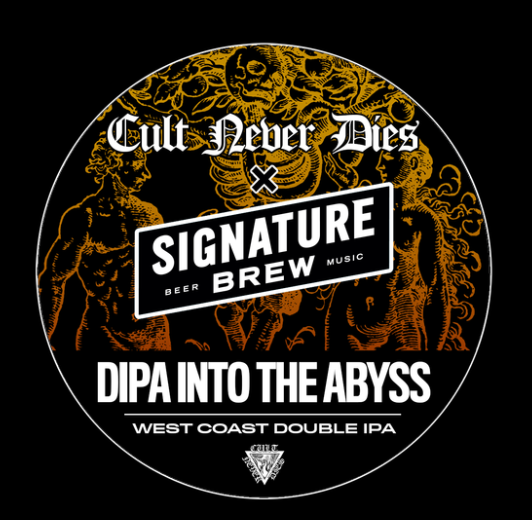
DM: Turning to the anniversary show — and the beer launch — can you talk us through what fans can expect and how the collaboration with Signature Brew came about?
DP: The connection with the bands is that all three have released music through our label. Yoth Iria are headlining. They’ve just signed to Metal Blade and Jim Mutilator from Rotting Christ is in that band. He was involved with us because of the official Rotting Christ book, and when he formed Yoth Iria, we released the CD of their first release. The other two bands, Heathen Deity and Stahlsarg, are two of the best UK black metal bands. We’ve released material by both and worked with them for years. I wanted it to be bands we’d released, all black metal, with decent-length sets — so three bands felt right.
The unusual thing is that the concert is at a brewery, Signature Brew. We’re releasing a 7.5% double IPA called DIPA Into the Abyss, a collaboration with them. One of their brewers, Stephen Wells, is from our world, and Signature Brew has a relationship with alternative music. They’ve hosted everyone from Raison d’Être to Suede.
We’d wanted our own beer for years. Everyone at Cult Never Dies is a fan of beer — that’s a red thread. Alcohol is a huge part of metal culture: venues depend on it and almost everyone I’ve worked with loves beer. Even when I wasn’t drinking for a few months, I was reading about beer. So it wasn’t a casual thing.
The stage is actually among the tanks where the beer is brewed. You’ll be able to stand and watch the bands and drink a beer brewed a few feet away. There’s something almost alchemical about that. It’s the first time Yoth Iria have headlined in the UK, and I feel like it’s a somewhat historic event done for love rather than money.
DM: And lastly, you’ve touched on parallels between craft beer and underground metal. What connects those worlds for you?
DP: There are definitely parallels. Nothing against Kronenbourg, but if we were doing a Cult Never Dies beer with Kronenbourg, it would feel wrong. The approach of brewers in the craft beer world is similar to musicians in metal. You’re doing something bespoke, hopefully higher quality, for a specific niche. It’s not mass-produced or driven by money. It’s about creating the best thing you can for like-minded people. That’s the red thread between craft beer, metal and us as a publishing house.
We’re not creating for a casual audience. The people who make this music love this music; the people who brew that beer love that beer. We write books because we’re passionate about the subject. The anniversary event is a celebration of dedication to arcane and underground interests.
For more on Cult Never Dies, visit www.cultneverdies.com
Comments